


Quick take
- Done: the Army detonated the nation’s entire stockpile of degraded lead azide, roughly 5 tons in 68 drums, at the Iowa Army Ammunition Plant near Middletown at about 9 a.m. CT today. Two detonations at two sites went off simultaneously, and the plume dissipated quickly. [S7] [S8] [S9]
- Latest readings: The BBC reports EPA air monitors at every sampling location still showed 0.00 µg/m³ of lead more than two hours after the blast. The EPA’s short-term screening level is 32 µg/m³. Acting Army Secretary Adam Telle called the detonation a “HUGE success” and said EPA sensors showed “no readings so far above 0.0.” At an 11:09 a.m. CT briefing, Maj. Gen. Eric Shirley said “every indication” is that the lead azide threat was eliminated and that the risk was reduced “as close to zero as is absolute humanly possible.” Those are official assessments. [S8] [S11]
- Not over yet: There is still no all-clear as of 12:05 p.m. CT. FEMA says everyone within 20 miles should keep sheltering in place, windows closed, until officials give that word. Evacuees in the 5-mile cone southwest of the plant will be told by phone when it is safe to return. FEMA Administrator Cameron Hamilton said more resources and testing will follow “in the coming days to weeks.” Soil and water results are still pending. [S8] [S11]
- Still in force: homes whose soil tests above 200 ppm lead will be cleaned at government expense, and blast-damage claims go through the U.S. Army Claims Service. FEMA Helpline: 1-800-621-3362. [S1]
- Chatter check: posts on X saying “USA drops dirty bomb on Iowa” are false as worded. Lead azide is a conventional detonator chemical, not radioactive material. The real concern is lead dust. [S1] [S7]
Our rating: ✅ Confirmed  Factual
Last updated November 25, 2026, 12:05 p.m. CT. We will update this post again when the all-clear is given and the first soil and water results are published.
The detonation happened, about 9 a.m. CT: ✅ Confirmed Factual Lean note: AP, the BBC and WQAD all report it, and an Army spokesman told ABC News there were two simultaneous detonations at two sites.
Air readings and official “success” statements: ✅ Confirmed Factual Lean note: The BBC reports 0.00 µg/m³ of lead at every EPA sampling location more than two hours after the blast, against a 32 µg/m³ short-term screening level. “Huge success” and “as close to zero as is absolute humanly possible” are the Army’s own assessments of those early results. Soil and water data, and any later declaration that the air, land or water is safe, are still pending.
All-clear and soil/water results: ❓ Unconfirmed Factual Lean note: Still pending as of 12:05 p.m. CT. No all-clear has been issued. FEMA says more testing will come over days to weeks, and that people within 20 miles should keep sheltering in place until officials give the all-clear.
Viral claim: “USA drops dirty bomb on Iowa”: ❌ False Factual Lean note: A dirty bomb spreads radioactive material. Lead azide is a lead-based primary explosive with no radiological component, per the Army’s and EPA’s descriptions. The hazard officials are tracking is lead dust.
Latest: 11:09 a.m. CT briefing
About an hour after the blast, Acting Army Secretary Adam Telle posted that the detonation “exceeded all expectations and was a HUGE success,” and that EPA sensors showed “no readings so far above 0.0.” [S11] At the 11:09 a.m. CT briefing, Maj. Gen. Eric Shirley of Army Sustainment Command said “every indication” is that the lead azide threat was eliminated and that the risk was reduced “as close to zero as is absolute humanly possible.” [S8]
The BBC, in an 11:38 a.m. CT entry, reported that EPA air monitors still showed 0.00 µg/m³ of lead at every sampling location more than two hours after the blast, well below the 32 µg/m³ short-term screening level. [S8] FEMA Administrator Cameron Hamilton said more resources and testing will follow “in the coming days to weeks.” [S8] ATF’s Rob Cekada said the degraded explosives had been a federal problem since 2009 and that a mitigation plan was built in March 2026. That is his statement as an official, not an independent finding. [S11]
The 5-mile evacuation cone southwest of the plant and the 20-mile shelter-in-place order remain in effect until officials give the all-clear. Evacuees will be told by phone when it is safe to return. [S8] [S11]
Update: the detonation
The Army carried out the controlled detonation at about 9 a.m. CT. Lt. Col. Orlandon Howard told ABC News, as relayed by WQAD: “There were two detonations at two different sites, detonated simultaneously. There was only one boom.” He said early indications were that it was “a successful detonation” and that assessments were under way. [S9] An AP reporter less than a mile away heard two loud booms and saw a wispy white plume that soon dissipated; WQAD crews nearby saw a small plume and said cloudy weather made the smoke hard to see. [S7] [S9]
A senior administration official told CBS News, the BBC’s U.S. partner, that “the explosion exceeded all expectations” and that “maximum mitigation efforts” were achieved. President Trump posted that early reports showed the Army’s mitigation efforts “far exceeded expectations.” [S8] These are early official statements; the test is the monitoring data.
Before the blast, FEMA sent an emergency alert telling everyone within 20 miles that evacuation was “no longer safe or advised” and to shelter in place immediately. After it, FEMA said residents in that zone “should continue to shelter in place” and follow EPA guidance “until given the all clear by officials.” [S8] [S9]
Chatter check: “USA drops dirty bomb on Iowa”
Posts on X call this a “dirty bomb.” That is false as worded. A dirty bomb is an explosive used to scatter radioactive material. Lead azide is a lead-based primary explosive used to set off munitions; the Army and EPA describe the risk as lead dust, not radiation. [S1] [S5] The Army did not “drop” anything: it destroyed degraded material in place, in its storage bunkers, after a federal appeals court let the operation proceed. [S3] Concern about lead exposure is legitimate and is covered below; the radiation framing is not.
What still has to be proven
Officials’ own planning estimated airborne lead dust could travel up to 100 miles depending on wind, and farmers in the projected plume path told the BBC they fear for their land. [S8] Two-plus hours of 0.00 µg/m³ air readings are a stronger early sign than the first minutes after the blast, but they are still only air data. FEMA says more testing will come over days to weeks, and EPA Administrator Lee Zeldin has said the agency will not rush to declare the air, land or water safe. [S8] [S11] Until the all-clear and the soil and water results are published, residents’ concerns are not resolved, and neither is the Army’s claim that most of the dust stayed on site.
How it got here
The Army says routine inspections found severe degradation and crystallization in about 68 drums of stored lead azide, more than 9,700 pounds net explosive weight, inside earth-covered magazines. In that state, the Army says, the primary explosive is sensitive to minimal friction, vibration, heat or shock, so moving it, opening the drums or treating it chemically was ruled out. Military explosive ordnance disposal teams from the 71st Explosive Ordnance Disposal Group were assigned to detonate it in place. [S1]
The detonation was first planned for last Friday and was delayed amid public backlash and a court fight. The Eighth Circuit Court of Appeals briefly stayed the permit, then denied the emergency motion to block it. [S3]
The Army lists two-story sand-filled barriers, soil backfill, water walls, foam and gel blocks, and misting units meant to keep most of the lead oxide dust inside the installation. Air sensors were set to run during the event, and mobile teams are to collect soil, surface-water and wipe samples along the plume path afterward. [S1] The EPA says it has taken more than 1,000 air, land and water samples before the detonation. [S5]
Cleanup, claims and the CDC
- Soil cleanup: “If any residential property tests above the RCRA-approved standard of 200 parts per million (mg/kg), environmental remediation teams will remove affected soil, clean surfaces, and restore the property at complete government expense,” the Army says. [S1]
- Damage claims: the Army says the U.S. Army Claims Service “will process and pay claims immediately” for physical property damage from blast vibrations. [S1]
- CDC: the CDC said Tuesday it activated an emergency response, is supporting Iowa’s health department on potential lead and air-pollution exposure, and has a team with toxicology, communication and emergency-response expertise. [S3]
- State response: Gov. Kim Reynolds issued a disaster emergency proclamation for Des Moines, Lee and Van Buren counties. Up to 100 federally activated Iowa National Guard soldiers are helping reach about 150 households. [S3] [S6]
If you live nearby: keep sheltering until the all-clear
These steps come from the Army and federal partners. [S1] [S2] [S4]
- Keep all exterior windows and doors closed until officials give the all-clear.
- Set your heating and air conditioning to recirculate indoor air. Turn off exhaust fans.
- A furnace filter rated MERV 11 or higher helps filter indoor air.
- Avoid unnecessary travel through the affected area and the relocation zone.
- Infants, children under six, pregnant women and people with chronic illnesses are most vulnerable to lead dust. They should avoid outdoor activity in affected areas until officials say otherwise.
- After the all-clear, wet-wipe high-contact surfaces such as patios, decks, window sills, outdoor play equipment, toys, tables, chairs and handrails. Wet-cleaning captures settled dust instead of stirring it up.
- Evacuees will be told by phone when the all-clear is given. Questions about the zone or eligibility: FEMA, 1-800-621-3362.
Both sides, same evidence bar
The federal case. Acting Army Secretary Adam Telle says there is “consensus across the experts” that a controlled, mitigated detonation is “far preferable to an uncontrolled, spontaneous detonation.” ATF Director Robert Cekada: “It’s just a matter of time when we have an uncontrolled detonation.” In denying the stay, the Eighth Circuit pointed to the risk of an unplanned blast that would happen without the permit’s safeguards. [S1] [S3]
The concerns. The Iowa Environmental Council and the Sierra Club Iowa Chapter argued lead dust could reach communities more than 100 miles away. They say they will not try to block the detonation further, but they want transparency. Governor-elect Rob Sand deferred to the administration while saying Iowans “are entitled to know how Middletown came to this situation.” [S3]
What we can test today. Officials, including the Army, President Trump, Missouri Gov. Mike Kehoe and Iowa Gov. Kim Reynolds, say the blast was well contained, and the early EPA air readings back that up so far. Critics, including elected officials cited by Axios and Rep. Thomas Massie and others on X, have focused on poor communication beforehand and on the timing. [S11] Whether the dust stayed mostly on site, as the Army projects, still depends on the soil and water results, which are not out yet.
What to watch
- The all-clear, and when evacuees in the 5-mile cone may return home. They are to be told by phone.
- The first EPA and Iowa soil and water results, including any homes over the 200 ppm cleanup line. FEMA says more testing will come over days to weeks.
- Whether officials later declare the air, land and water safe. EPA Administrator Zeldin has said the agency will not rush that call.
- How the Army Claims Service handles damage claims.
Sources
- [S1] U.S. Army, “Army announces controlled detonation of degraded explosive material at Iowa Army Ammunition Plant,” November 24, 2026 (official; Factual)
- [S2] U.S. Army Sustainment Command (Lori McFate), “Public Safety Advisory: Controlled, Mitigated Detonation of Unstable Lead Azide at Iowa Army Ammunition Plant,” November 24, 2026 (official; Factual)
- [S3] Meredith Deliso, ABC News, “Army’s lead azide detonation set for Wednesday at Iowa plant following delays,” November 25, 2026 (Factual)
- [S4] Jeanine Santucci, USA Today, “Lead azide detonation in Iowa happening today. Live updates,” November 25, 2026 (Factual)
- [S5] U.S. EPA, “EPA, Army and Other Federal Partners Provide Public Update on Iowa Army Ammunition Plant” (official; Factual)
- [S6] KCRG, “Gov. Reynolds issues disaster emergency proclamation ahead of lead azide detonation Wednesday,” November 24, 2026 (Factual)
- [S7] Ty ONeil, John Seewer and Scott Bauer, AP, “Army blows up bomb chemicals in Iowa despite fears a toxic plume could endanger residents,” November 25, 2026 (Factual); see also AP live updates (“Monitors did not report any lead in the air immediately after”)
- [S8] BBC News live page, “Blasts heard as US Army carries out controlled detonation of degraded explosives in Iowa,” November 25, 2026 (Factual)
- [S9] WQAD News 8, “LIVE UPDATES: Army detonates nation’s stockpile of lead azide in Iowa,” November 25, 2026 (Factual)
- [S10] Missouri Gov. Mike Kehoe statement, as quoted on the BBC live page, November 25, 2026 (official statement)
- [S11] Axios, “Army detonates lead azide at Iowa plant,” November 25, 2026 (Factual)
- [S12] U.S. EPA, “EPA Collects Over 1,200 Air, Land and Water Samples Ahead of Iowa Army Ammunition Plant Detonation” (official; Factual)
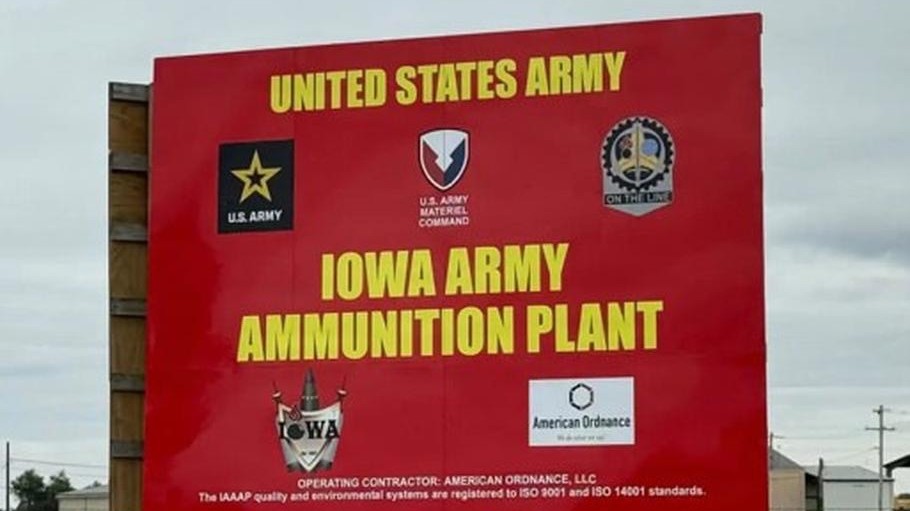
Featured image: United States Army Iowa Army Ammunition Plant sign, 2026, by Lori McFate, Iowa Army Ammunition Plant / U.S. Army Sustainment Command. Public domain (U.S. Army work), via Wikimedia Commons; cropped. Full list on our image credits page.