


Quick take
- A hard freeze is one brutal night. A long freeze is days of it, sometimes with the grid down. February 2021 showed both. The plan has to cover pipes, heat, water, food and generator safety, not just a faucet cover.
- Dallas–Fort Worth averages 29.2 nights at or below 32°F each year, with a typical freeze season from November 22 to March 12 (National Weather Service Fort Worth, 1991–2020 climate normals). Freezes here are not rare. The rare event is a multi-day freeze with the power out.
- At Dallas–Fort Worth Airport, Winter Storm Uri brought 139 straight hours at or below freezing, from 5 p.m. on February 13 to noon on February 19, 2021, and an official low of −2°F on February 16 (NWS Fort Worth).
- The Texas grid operator, ERCOT, ordered 20,000 MW of rolling blackouts to keep the system from collapsing, which the Federal Energy Regulatory Commission called the largest manually controlled load-shedding event in U.S. history. More than 4.5 million people in Texas lost power, some for as long as four days (FERC–NERC, November 2021).
Our rating: ✅ Confirmed  Factual (NWS climate and event records, the official FERC–NERC inquiry, the Texas DSHS mortality report, and federal safety guidance from Ready.gov, CPSC, NFPA and FoodSafety.gov)
People still talk about a hard freeze as if it were a once-in-a-decade surprise, especially in places that think of themselves as mild. The weather record says otherwise. What February 2021 added was duration: nights that never let go, and a grid that could not keep up. That is the event a household plan has to be built for.
A hard freeze is one night. A long freeze is a test.
A hard freeze is a single brutal night: the temperature drops to 32°F or below, and it stays there long enough to damage plants and threaten exposed pipes. A long freeze is days of that, sometimes with ice on the lines and no electricity. Duration is what changes the problem.
Pipes can survive a short dip if the house stays warm. Leave the heat off for two or three days, and water in the walls, the attic and the crawlspace has time to freeze solid, expand and split the line. When the thaw comes, the leak is already there. People are the same: a cold night is miserable. Several days without heat, water or a way to cook is a medical problem, especially for older adults, infants and anyone who depends on powered equipment.
That is why a faucet cover is not a plan. A plan covers heat, water, food, medicine and a generator that will not poison the house.
How often it actually freezes
Use the local National Weather Service office normals, not slogans. For Dallas–Fort Worth, the 1991–2020 climate normals show an average of 29.2 days a year with a low of 32°F or below (NWS Fort Worth annual normals, Factual). The typical first freeze is November 22; the typical last freeze is March 12 (NWS Fort Worth freeze summary, Factual). That is a four-month season, not a freak event.

January alone averages 10.6 of those nights; December averages 8.1; February averages 6.2. The rare event is not a freeze. The rare event is a freeze that lasts for days with the power out.
February 2021: 139 hours, and then the lights went out
Winter Storm Uri was that event. At Dallas–Fort Worth Airport, NWS Fort Worth recorded 93 hours at or below freezing from 5 p.m. on February 9 to 2 p.m. on February 13, then, after a brief rise to 33°F, 139 straight hours at or below freezing from 5 p.m. on February 13 to noon on February 19. The official low was −2°F on February 16 (NWS Fort Worth event summary, Factual). The all-time record low at DFW is still −8°F, on February 12, 1899. Uri was not the coldest night in the record book. It was one of the longest.

While the cold held, the grid failed. A FERC, NERC and regional-entity inquiry found that ERCOT ordered a total of 20,000 MW of rolling blackouts to prevent a collapse of the system, “the largest manually controlled load shedding event in U.S. history.” More than 4.5 million people in Texas lost power, some for as long as four days (FERC news release, November 16, 2021, Factual; FERC–NERC final report, Factual).
The same report says ERCOT averaged 34,000 MW of generation unavailable for more than two consecutive days, from 7 a.m. on February 15 to 1 p.m. on February 17, “equivalent to nearly half of its all-time winter peak electric load of 69,871 MW.” FERC and NERC found that a combination of freezing equipment (44.2 percent) and fuel problems (31.4 percent) caused 75.6 percent of the unplanned generating-unit outages, derates and failures to start.
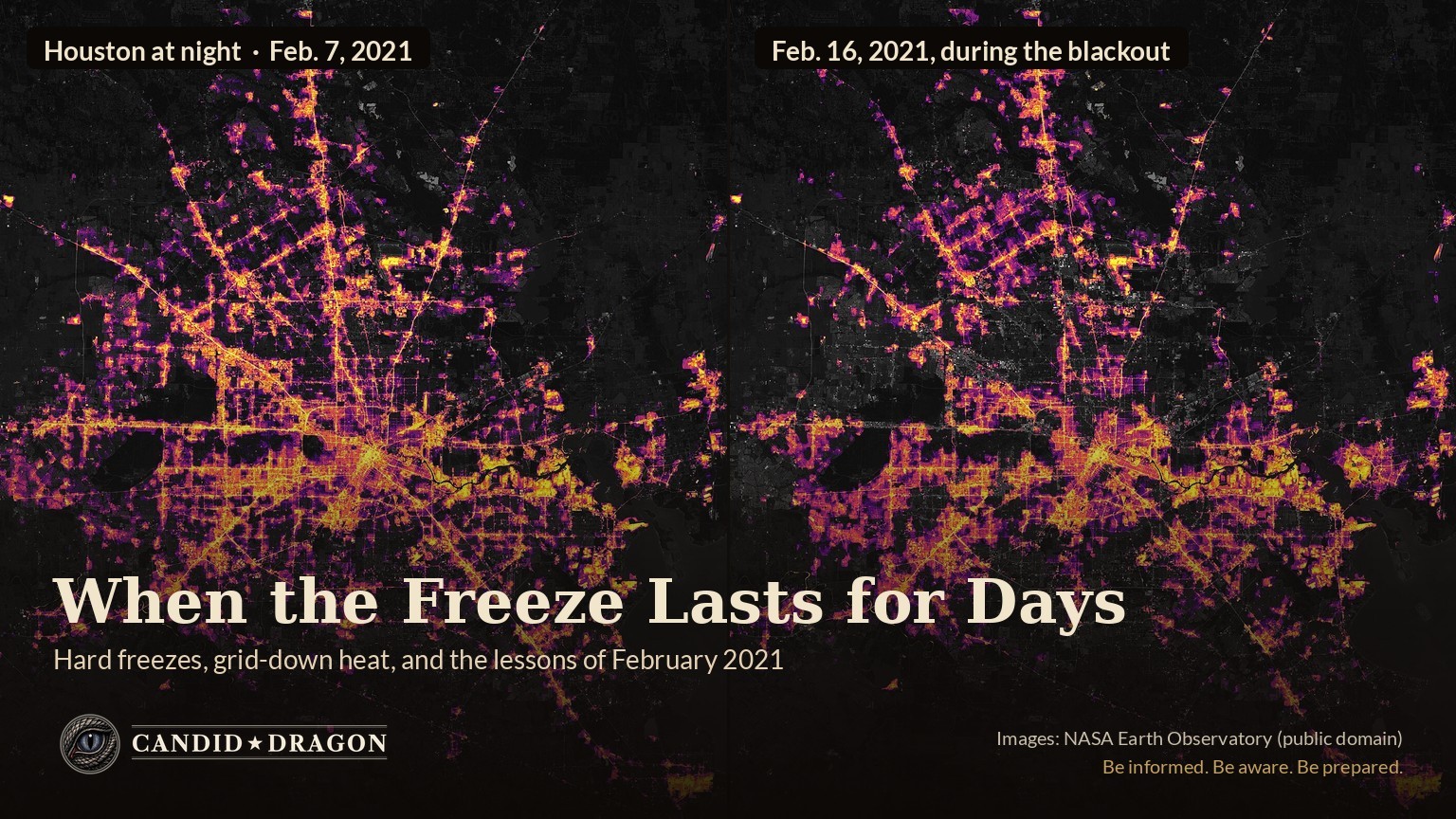
NASA Earth Observatory’s night images of Houston make the scale visible: a city lit on February 7, and the same city darkened on February 16, in the middle of the outage. The images are public domain.

The human cost is in the official Texas count, and it should be labeled as such. The Texas Department of State Health Services, in its winter-storm mortality report current as of October 27, 2021, confirmed 246 winter-storm-related deaths across 77 counties, with dates of death spanning February 11 to June 4, 2021 (later deaths include people injured during the storm who died afterward, and people whose bodies were found later). Of those 246, DSHS attributed 158 (64.2 percent) to hypothermia and 19 (7.7 percent) to carbon monoxide poisoning from “inappropriate use of generators, grills, heaters, vehicles running in enclosed spaces, and ice obstructing vents in gas powered heating equipment.” Another 10 (4.1 percent) were from fire-related injuries, including space heaters too close to things that burn (Texas DSHS, February 2021 Winter Storm-Related Deaths, Factual). Those are DSHS’s figures, verified by medical certifiers. Earlier public counts, including the “at least 210” cited in the November 2021 FERC–NERC report, were lower because the state’s surveillance was still open.
Water, if the pipes and the plant both fail
In a long freeze, tap water can fail two ways at once: a pipe bursts inside the house, or the system that treats and pumps water loses power. Ready.gov’s baseline is still the one to beat: one gallon per person per day, for several days, already stored, before the shelves empty (Ready.gov, Water, Factual). A family of four planning for three days needs 12 gallons. Pets count too. Buy it when the forecast is still a watch, not when the warning is already up.
Know the main water shutoff and make sure it turns, before you need it (Texas A&M AgriLife Extension). If a pipe freezes, keep that faucet open and thaw it with a hair dryer, a heating pad or warm towels. No open flame (American Red Cross, frozen pipes, Factual; AgriLife, Preventing and Thawing Frozen Pipes, Factual).
Deeper dive: Emergency water storage basics. If you want a container in one place, the Supply Depot lists a 7-gallon water storage container. You can buy the same thing at any hardware store. The stored water matters more than where you bought the jug.
Heat when the grid is down
This is the section that has to be gotten right. A generator can keep the heat and the pipes alive in a long freeze. It can also kill you with carbon monoxide if you run it in a garage, on a porch, or too close to a window. DSHS’s 19 carbon monoxide deaths in February 2021 were not an abstraction. They came from generators, grills, heaters and running vehicles used the wrong way, in enclosed spaces, or with vents blocked by ice.

The rules are not complicated, and they are official:
- Never heat the house with a gas stove or oven. Ready.gov is direct about this (Ready.gov, Winter Weather, Factual).
- Generators stay outdoors, at least 20 feet from windows, doors and vents, with the exhaust pointed away. Never in a garage, even with the door open. Test the generator before the storm (U.S. Consumer Product Safety Commission, Carbon Monoxide Information Center, Factual; Ready.gov, Power Outages, Factual).
- Put a battery or battery-backup carbon monoxide alarm on every level and outside sleeping areas, and test it. This is not optional if you own a generator, a gas furnace or a vehicle in an attached garage.
- Space heaters stay 3 feet from anything that can burn (National Fire Protection Association, heating safety, Factual). DSHS recorded fire deaths in 2021 from heaters placed too close to ignitable materials.
- If the heat is out: live in one room, close off the unused rooms, put towels under the doors, and close the curtains (Ready.gov).
A dual-fuel generator — one that can run on gasoline or propane — does not change any of those placement rules. What it does change is your fuel options. Gasoline is easy to find on an ordinary week and can be hard to find, or unsafe to store for long, when everyone else is buying it at the same time. Propane stores longer in a closed cylinder. Having both is a hedge, not a license to run the machine indoors.
The full outage plan, including generator and carbon monoxide rules, is here: Lights Out: A Power-Outage Plan That Also Covers a Solar Storm.
Food and medicine for several days without power
Store several days of food you can eat with no cooking, plus a manual can opener (Ready.gov). Keep the refrigerator and freezer shut. FoodSafety.gov and Ready.gov use the same numbers: a closed refrigerator holds about 4 hours; a full, closed freezer about 48 hours (about 24 hours if it is only half full). Throw out perishable food that has been at 40°F or higher for two hours or more (FoodSafety.gov, Food Safety During a Power Outage, Factual).
Prescriptions and medicines that need to stay cold are a special case. Ask your pharmacist, before the storm, how long each one keeps and what to do if the power is out for more than a day. If the outage lasts that long, Ready.gov says to discard refrigerated medicines unless the label says otherwise, and to call the pharmacist. A written list of medications, doses and doctors belongs in the kit, not only on a phone that may be dead.
Deeper dives: Home food storage basics, What to buy before a winter storm and Family medical and trauma kit. The Supply Depot lists a freeze-dried meal bucket, a hand-crank emergency radio, an LED lantern set and a power-outage bundle. Everything on this list is also sold at ordinary stores. The list matters more than the store.
A countdown: now, days out, the night before, during, after
Freezes usually give warning. Use it. This is the short version; the longer house-and-car checklist is in Winter Storm Readiness: Home, Car, and the Warnings That Matter.
Now, before any forecast
- Find the main water shutoff and confirm it turns. Insulate pipes in the attic, garage, crawlspace and along outside walls. Buy outdoor faucet covers while the shelves are full.
- Put a battery or battery-backup carbon monoxide alarm on every level and outside sleeping areas, and test it monthly.
- Have the heating system serviced. Clean gutters and trim limbs that hang over the roof or power lines.
- Build the basics: several days of no-cook food and a manual can opener; flashlights and batteries; a battery or hand-crank radio; prescriptions and pet supplies (Ready.gov).
- Turn on Wireless Emergency Alerts and pick an out-of-area check-in contact. See Staying in Touch When the Power or Internet Goes Down. Texas readers can sign up for ERCOT TXANS (Factual).
- If you own a generator, test-run it outdoors, 20 feet from the house, and store fuel safely. A dual-fuel model is a plus; the placement rules do not change.
3–5 days out, when a freeze shows up in the forecast
- Store the water: one gallon per person per day for several days.
- Top off food and medicine. Charge power banks. Fill the gas tank, and if you use propane, check the cylinders.
- Know the alerts. A Winter Storm Watch usually comes 12 to 48 hours ahead; a Warning, 12 to 24 hours ahead (Ready.gov). The time to shop is before the warning.
1–2 days out
- Disconnect hoses and cover the outdoor faucets. Drain sprinkler lines per the manufacturer, never with antifreeze (Red Cross).
- Pack a car kit: jumper cables, sand or kitty litter, a flashlight, warm clothes, blankets, water and snacks (Ready.gov).
- Charge phones. Set out blankets and warm layers for everyone.
The night before
- Drip the faucets on exposed lines.
- Open the sink cabinets on outside walls.
- Hold the thermostat steady day and night. If you are away, set it no lower than 55°F (Red Cross).
- Close the garage door if there are water lines inside.
During
- Space heaters stay 3 feet from anything that burns. Never heat with a gas stove or oven. Generators stay outside, 20 feet from the house, exhaust pointed away.
- Keep the fridge and freezer shut.
- Know the signs of frostbite (numbness; white or grayish-yellow, firm or waxy skin) and hypothermia (shivering, confusion, fumbling hands, slurred speech, drowsiness). A body temperature below 95°F is an emergency (Ready.gov).
- Stay off the roads if you can. If you are stranded, stay with the car, run the engine about 10 minutes an hour, crack a window and keep the exhaust pipe clear (Ready.gov).
- A pipe froze? Keep that faucet open and thaw it with a hair dryer, heating pad or warm towels. No open flame.
After
- Walk the house: water pressure at every faucet, no ceiling stains, and the meter still with everything off.
- Never touch a downed line. Watch for falling ice and branches (Ready.gov).
- Check on older neighbors and families with infants, then restock what you used.
Our view (opinion)
The useful lesson of February 2021 is not that winter arrived in Texas. Winter arrives every year. The useful lesson is that a plan built for one cold night will not hold up to four days without power. Build for the long freeze: stored water, a way to stay warm that does not involve a gas oven, food that does not need the stove, and a generator that lives outdoors. If that plan is in place, an ordinary hard freeze is just a hard freeze.
Related: Winter storm readiness for the home and car · What to buy before a winter storm · Power outage preparedness · Emergency water storage basics · Home food storage basics · 72-hour emergency kit checklist · Black Sky: what a nationwide blackout would look like · Doomsday Dashboard (live weather alerts)
Sources
- National Weather Service Fort Worth, Dallas/Fort Worth annual normals, means, and extremes (1991–2020). Factual. 29.2 days a year with a minimum of 32°F or below.
- National Weather Service Fort Worth, DFW freeze summary. Factual. Average first freeze November 22; average last freeze March 12 (data through the winter of 2023–2024).
- National Weather Service Fort Worth, February 2021: Historic Winter Storm and Arctic Outbreak. Factual. 93 hours and 139 hours at or below freezing at DFW Airport; official low −2°F on February 16, 2021.
- Federal Energy Regulatory Commission, Final Report on February 2021 Freeze Underscores Winterization Recommendations, November 16, 2021. Factual. ERCOT ordered 20,000 MW of rolling blackouts; more than 4.5 million people in Texas lost power, some for as long as four days.
- FERC, NERC and regional entities, The February 2021 Cold Weather Outages in Texas and the South Central United States, November 2021. Factual. 34,000 MW of ERCOT generation unavailable from 7 a.m. February 15 to 1 p.m. February 17; 69,871 MW all-time winter peak load; freeze-related and fuel-related shares of unplanned outages.
- Texas Department of State Health Services, February 2021 Winter Storm-Related Deaths, report dated December 31, 2021, data current as of October 27, 2021. Factual. 246 confirmed winter-storm-related deaths; 158 (64.2%) hypothermia; 19 (7.7%) carbon monoxide poisoning; 10 (4.1%) fire-related.
- NASA Earth Observatory, Extreme Winter Weather Causes U.S. Blackouts, February 2021. Factual. Public-domain night images of Houston, February 7 and February 16, 2021.
- Ready.gov (FEMA), Winter Weather. Factual.
- Ready.gov (FEMA), Power Outages. Factual.
- Ready.gov (FEMA), Water. Factual.
- U.S. Consumer Product Safety Commission, Carbon Monoxide Information Center. Factual.
- National Fire Protection Association, Heating safety. Factual. Space heaters at least 3 feet from anything that can burn.
- FoodSafety.gov, Food Safety During a Power Outage. Factual.
- American Red Cross, Preventing and Thawing Frozen Pipes. Factual.
- Texas A&M AgriLife Extension, Winter Storms: Preventing and Thawing Frozen Pipes. Factual.
- ERCOT, TXANS. Factual.
Featured image: Composite by Candid Dragon of NASA Earth Observatory night images of Houston on February 7, 2021, and February 16, 2021, during the Texas blackout. NASA Earth Observatory, Extreme Winter Weather Causes U.S. Blackouts, public domain; also via Wikimedia Commons (February 7 and February 16). Use of these images does not imply endorsement by NASA. In-body chart and Uri graphic are original Candid Dragon work from NWS Fort Worth published data. Ice-loaded lines: NOAA, public domain, via Wikimedia Commons, IceStormPowerLines. See all image credits.
Be informed. Be aware. Be prepared.