


This guide ranks every common way to start a fire from easiest to hardest. It assumes total shutdown: no electricity, no stores, and no help for days. It leans on the US Army’s survival manual and standard scout practice, and it gives you one standard method so you can act fast. Print the checklist and put a fire kit in your pack, your car and your kitchen drawer.
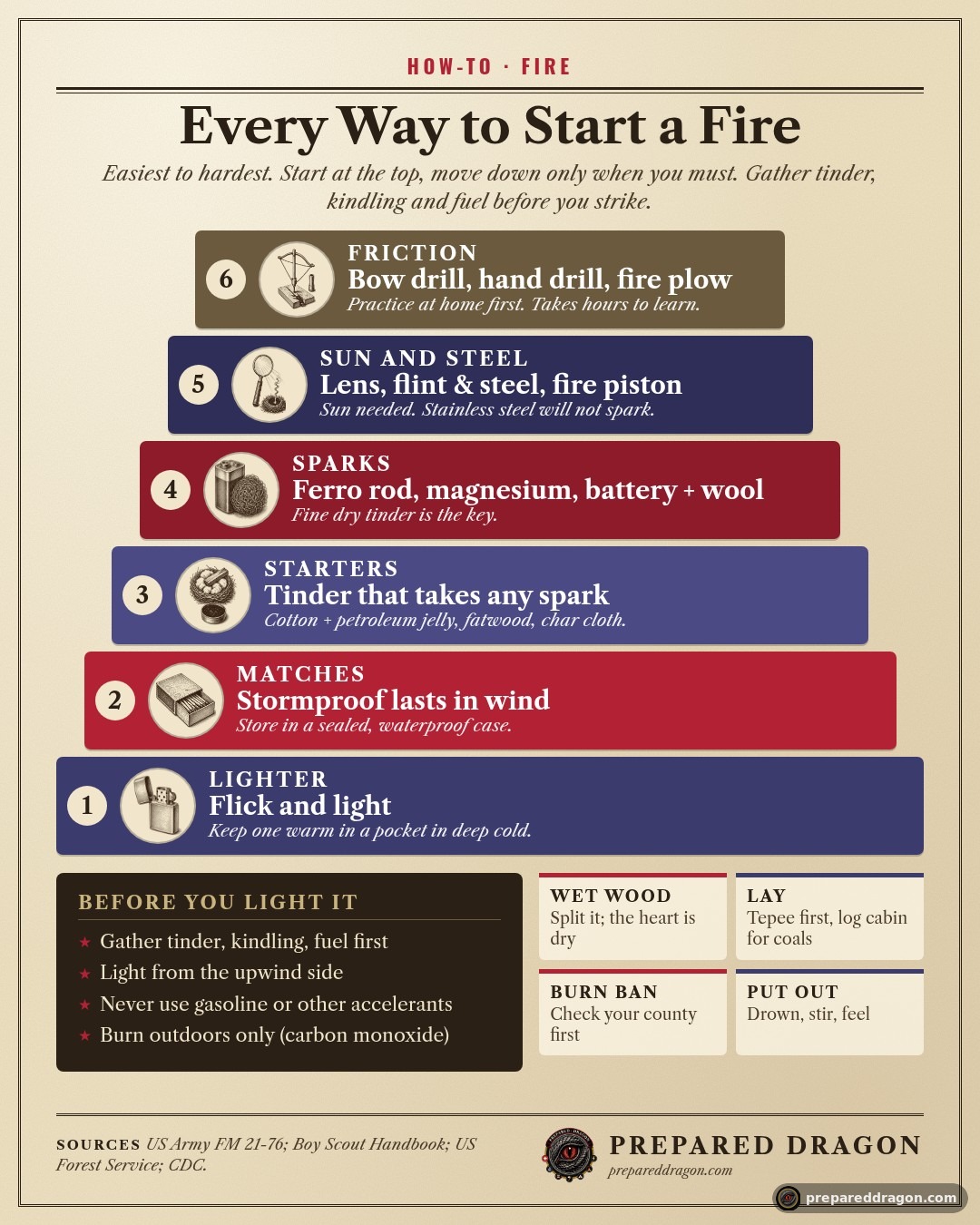
The Ladder at a Glance
| # | Method | Skill (1-5) | Wet or windy? | You need |
|---|---|---|---|---|
| 1 | Lighter | 1 | Weak in deep cold or if soaked | A lighter with fuel |
| 2 | Matches (stormproof) | 1 | Stormproof: yes. Plain matches: no | Waterproof case |
| 3 | Starters and tinder | 1 | Fatwood and jelly cotton: yes | Prepped before you need them |
| 4 | Ferro rod | 2 | Yes. Wipe it dry | Fine dry tinder |
| 5 | Magnesium block | 3 | Yes | Ferro rod and a knife |
| 6 | Battery and steel wool | 2 | Keep the wool dry | 9-volt and 0000 steel wool |
| 7 | Magnifying lens | 3 | Needs bright sun | A lens and dry tinder |
| 8 | Flint and steel | 3 | Sparks work wet, tinder must be dry | Flint, carbon steel, char cloth |
| 9 | Fire piston | 4 | Yes, if the char cloth is dry | Piston and char cloth |
| 10 | Potassium permanganate and glycerin | 2 (hazardous) | Mostly | Both chemicals, kept apart |
| 11 | Bow drill | 4 | No, needs dry wood | Fireboard, spindle, socket, bow |
| 12 | Hand drill | 5 | No | Spindle and fireboard |
| 13 | Fire plow | 5 | No | Hardwood shaft, softwood base |
Before You Strike Anything: Fire Basics
A fire needs three things to burn: oxygen, heat, and fuel. Without any one of them the fire goes out.
| Stage | What it is | Examples |
|---|---|---|
| Tinder | Dry material that catches from a spark or small flame | Dry grass, cotton balls, char cloth, birch bark, dryer lint |
| Kindling | Small sticks that feed the flame from tinder | Pencil-thin twigs, split feather sticks |
| Fuel | Larger wood that keeps the fire going | Thumb-thick sticks up to wrist-thick logs |
- Gather tinder bundle first
- Gather pencil-thin kindling
- Gather thumb-thick sticks
- Gather wrist-thick fuel
- Build on a dry platform of rocks or green sticks
- Keep water and a shovel ready
Pick a Fire Lay
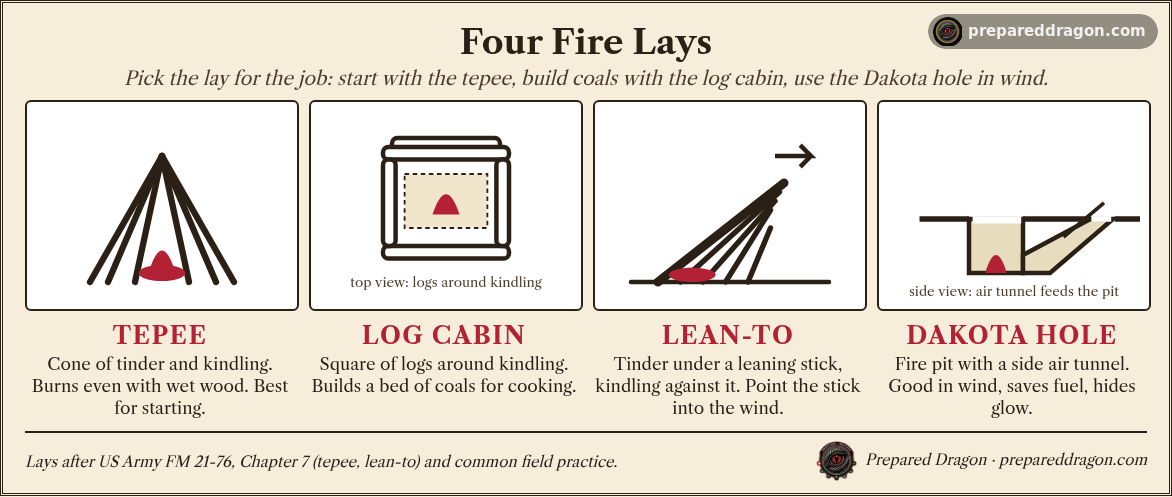
Tepee
Arrange tinder and a few sticks of kindling in a cone shape. Light the tinder in the center. As the kindling burns the outer sticks fall inward and feed the fire. This lay works even with damp wood once the center catches.
Log Cabin
Place two logs parallel on the ground and set two more across them to form a square around your tinder and kindling. Add more layers in the same pattern. The structure creates steady airflow and builds a bed of coals. It works well for cooking once the fire settles.
Lean-To
Push a sturdy green stick into the ground at a 30-degree angle so it points into the wind. Place tinder under the low end and lean kindling against the stick. Add more kindling as each piece catches, then fuel. The angled stick shelters the tinder from the wind.
Dakota Hole
Dig a pit about a foot across and a foot deep with a narrow tunnel at the base for air to enter from the side. Set tinder and kindling in the pit and light from the top. The hole hides the glow and uses less fuel while the side tunnel supplies oxygen. It performs well in wind or when you need to stay low profile.
The Army’s FM 21-76 also describes a cross-ditch lay that scratches a shallow X in the ground for airflow under the tinder and a pyramid lay that stacks logs in layers with the starter fire on top so the fire burns downward with little tending.
The Ladder: Every Method, Easiest to Hardest
Start with what is already in your pocket or pack. Move down the ladder only when the easier tools fail. Ratings: 1 is easy, 5 is hard.
1. Lighter
Press the button and hold the flame to your tinder bundle until it catches. Keep the lighter warm in an inner pocket because butane lighters become unreliable in deep cold. Use it first in any dry or sheltered spot where wind is low.
2. Matches, Including Stormproof Matches
Strike the match and cup the flame close to fine tinder so it ignites before the wind takes it. Stormproof matches keep burning even when rain or wind hits them. Carry them in a waterproof case and use them when a lighter fails or when you need a longer flame to start damp material.
3. Fire Starters and Tinder
These items help every other method work faster and more reliably. Cotton balls smeared with petroleum jelly burn longer than plain cotton, fatwood lights even when damp, and char cloth catches a spark with little effort. Form a loose bird’s-nest bundle of any of them and place it where your spark or flame lands first.
4. Ferro Rod
Scrape or strike the rod with a hard edge to shower hot sparks onto fine dry tinder. The rod works after it gets wet once you wipe it dry. Use it when matches and lighters are gone or when you need sparks in damp conditions.
5. Magnesium Block
Scrape thin shavings from the block into a small pile on your tinder, then spark the shavings with a ferro rod. The shavings catch quickly and transfer heat to the tinder below. Keep the block dry and use it only after simpler spark methods fail.
6. Battery and Steel Wool (9-Volt)
Touch both terminals of a 9-volt battery to fine 0000 steel wool so the wool glows and burns into your tinder. The Army field manual also shows attaching wires to battery terminals and touching the bare ends together beside tinder to create sparks. Do not carry a battery loose in a pocket with metal objects because they can short and heat up.
Warning: Short circuits from batteries and metal can cause burns or start unintended fires. Keep batteries separate from coins, keys, or steel wool at all times.
7. Magnifying Lens and Solar Methods
Point a convex lens at dry tinder on a bright sunny day and hold the focused spot until the tinder smolders, then blow gently to flame. Use the lens from binoculars, a camera, or a magnifying glass. A clear water-filled bottle or an ice lens can focus sunlight but work slowly and often fail.
8. Flint and Steel
Strike a piece of flint or another hard sharp rock with carbon steel only to throw sparks onto fine tinder. Stainless steel will not produce useful sparks. This method is reliable once you learn the loose-wrist motion, and you blow on the spark once it lands.
9. Fire Piston
Place a small piece of char cloth inside the sealed cylinder, then give the plunger a fast hard push. The sudden compression heats the air enough to create an ember. Transfer the ember to your tinder bundle and blow it into flame.
10. Chemical Method: Potassium Permanganate and Glycerin
Place a small pile of potassium permanganate crystals at the fire lay and add a few drops of glycerin. After a short delay the mixture heats and flames. Use this only as a last resort.
Warning: Potassium permanganate stains and irritates skin and eyes. Keep it away from skin, other chemicals, and children. Store the two substances separately and mix them only at the fire lay. Never mix them in a closed container.
11. Bow Drill
Assemble a fireboard with a small notch cut in it, a spindle, a socket, and a bow with cord to spin the spindle against the fireboard. The friction grinds hot wood dust into a glowing ember that falls into the notch. Tip it onto a tinder nest and blow it into flame. The method takes steady effort and persistence.
12. Hand Drill
Spin a straight spindle between your palms against a fireboard to create hot dust that forms an ember. The technique works the same way as the bow drill but without the bow, so it demands more sustained effort. Keep your hands moving quickly and add pressure as the dust darkens.
13. Fire Plow
Cut a groove in a softwood base and plow the blunt tip of a hardwood shaft up and down the groove. Friction heats the wood particles until they ignite. Move steadily and keep the groove clear of debris.
Friction fire is a skill to practice at home before you need it.
Prepared Dragon Standard Method: Tepee First, Ferro Rod as the Reliable Igniter
Gather tinder, kindling and fuel first. Light a tepee from the upwind side with a lighter or stormproof matches, and carry a ferro rod and a tin of char cloth as backup. Where sources disagree on which lay or igniter is best, we choose the safest proven method. The Army manual lists the tepee as burning well even with wet wood, so we start there. Boy Scout and Army sources agree on the fuel ladder: tinder, kindling, then fuel. For friction methods, practice at home first.
Wet Weather and Wind: How to Light Anyway
- Use standing dead wood rather than wood lying on wet ground.
- Split wet logs to reach the dry heartwood inside.
- Shave feather sticks from dry inner wood to create fine tinder.
- Look for dead twigs sheltered under evergreen boughs.
- Build the fire on a platform of green sticks or rocks to keep it off damp soil.
- Shield the fire lay from rain with a tarp or natural windbreak.
- Dry damp wood near the fire before adding it to the flames.
- Carry a supply of dry tinder in a sealed bag at all times.
Fire Safety and Putting It Out
Keep a bucket of water and a shovel beside any fire. Build the fire at least ten feet from tents, vehicles, or dry grass and clear all overhanging branches. Never leave the fire unattended. Extinguish it completely before you walk away.
Warning: Never use gasoline or other accelerants. Never burn charcoal or run a grill or camp stove indoors, because of carbon monoxide risk. Burn wood indoors only in a fireplace or stove with a working chimney.
- Drown the fire with water until no hissing or steam remains.
- Stir the ashes and embers thoroughly with a shovel.
- Feel for heat with the back of your hand, then touch carefully. Everything must feel cold before you leave.
Texas Rules Before You Light
Counties can order outdoor-burning bans in dry weather. Check the Texas A&M Forest Service burn-ban information and local rules before lighting an outdoor fire. In a true emergency a small contained cooking fire may be needed for survival, but wildfire danger remains real in Texas.
Printable Fire Kit Checklist
- Lighter
- Second lighter
- Stormproof matches
- Ferro rod
- Cotton balls in a sealed bag
- Fatwood pieces
- Char cloth in a small tin
- Fine steel wool
- Small knife
- Candle stub
- Metal cup or tin
- Dry sealed bag for tinder
Frequently Asked Questions
What is the easiest way to start a fire?
Strike a match or lighter onto a prepared bird’s-nest of dry tinder. Add kindling once the tinder catches, then larger fuel.
What if everything is wet?
Split wet wood to reach dry heartwood. Use standing dead branches and carry dry tinder in a sealed bag. Build on a raised platform and shield the lay from rain.
Can I use a lighter in the cold?
Butane lighters often fail in deep cold. Keep one warm in an inner pocket and have a ferro rod or stormproof matches as backup.
Is the chemical method safe?
Potassium permanganate and glycerin works but stains skin and irritates eyes. Mix only at the fire lay in open air, keep the chemicals separate until needed, and store them away from children.
Related: Read Hunting and Food Procurement for cooking and preserving game, and the 3-Day Power Outage Guide for cooking fire safety.
Prep Ahead: Gear for This Guide
A good fire kit costs little. Build one now and keep it with your pack.

UCO Stormproof Matches
UCO Stormproof matches that are waterproof and windproof, for a kit or pack.
See price at Amazon
Multi-Tool and Fire-Starting Kit
A ferro rod and striker to get a fire going, paired with a compact multitool for bags and packs.
See price at Amazon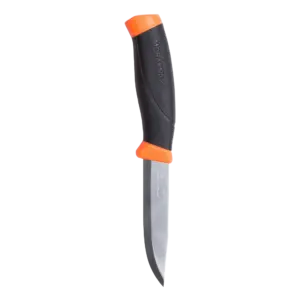
Morakniv Companion (S) Stainless Fixed-Blade Bushcraft Knife
A Morakniv Companion stainless fixed-blade knife for camp and bushcraft.
See price at Amazon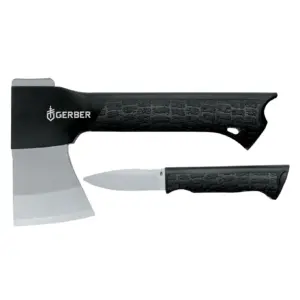
Gerber Gator Combo Axe (axe with knife in handle)
A Gerber Gator combo axe with a knife stored in the handle.
See price at Amazon
Starter Prepper Kit (the whole lot)
The gift that keeps them safe. Everything a new prepper needs in one cart: water, food, light, power, first aid, fire, warmth, tools and a hand-crank radio, built around a…
See price at Amazon
Bushcraft 101: A Field Guide to the Art of Wilderness Survival
Dave Canterbury's 256-page field guide built around the five Cs of survivability: cutting tools, covering, combustion, containers and cordage. A readable first book on outdoor skills. See current price and…
See price at Amazon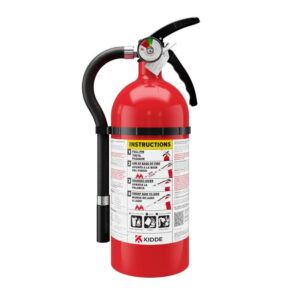
Kidde Home Fire Extinguisher, 2-A:10-B:C
A 2-A:10-B:C multipurpose home fire extinguisher from Kidde's official store.
See price at Amazon- Gerber Gear Fire Starter Ferro Rod: a ferro rod with a striker and a whistle
- UST WetFire Tinder Cubes: tinder that lights when damp
- Pine Fatwood Fire Starter Sticks: natural resin-rich fire starter
- UCO Stormproof Matches: keeps burning in wind and rain
- Multi-Tool and Fire-Starting Kit: multi-tool and ferro rod kit
- Morakniv Companion Stainless Fixed-Blade Bushcraft Knife: strikes a ferro rod and shaves feather sticks
- Gerber Gator Combo Axe: splits wet wood to reach dry heartwood
- Starter Prepper Kit: a ready kit that includes fire starters
- Bushcraft 101: A Field Guide to the Art of Wilderness Survival: a book on firecraft and bushcraft
- Kidde Home Fire Extinguisher: keep one at home
More: Survival Guides & Books in the Prepared Dragon shop. Some links on this page are affiliate links.
Sources
- US Army, FM 21-76 Survival, Chapter 7, Firecraft (public domain); and ATP 3-50.21 Survival, Army Publishing Directorate.
- Boy Scouts of America, Scout Handbook and Fieldbook fire-building sections (paraphrased, not quoted).
- US Forest Service / Smokey Bear, Campfire Safety
- CDC, What to Do to Protect Yourself During a Power Outage
- Texas A&M Forest Service, outdoor burning and burn-ban information, tfsweb.tamu.edu.